
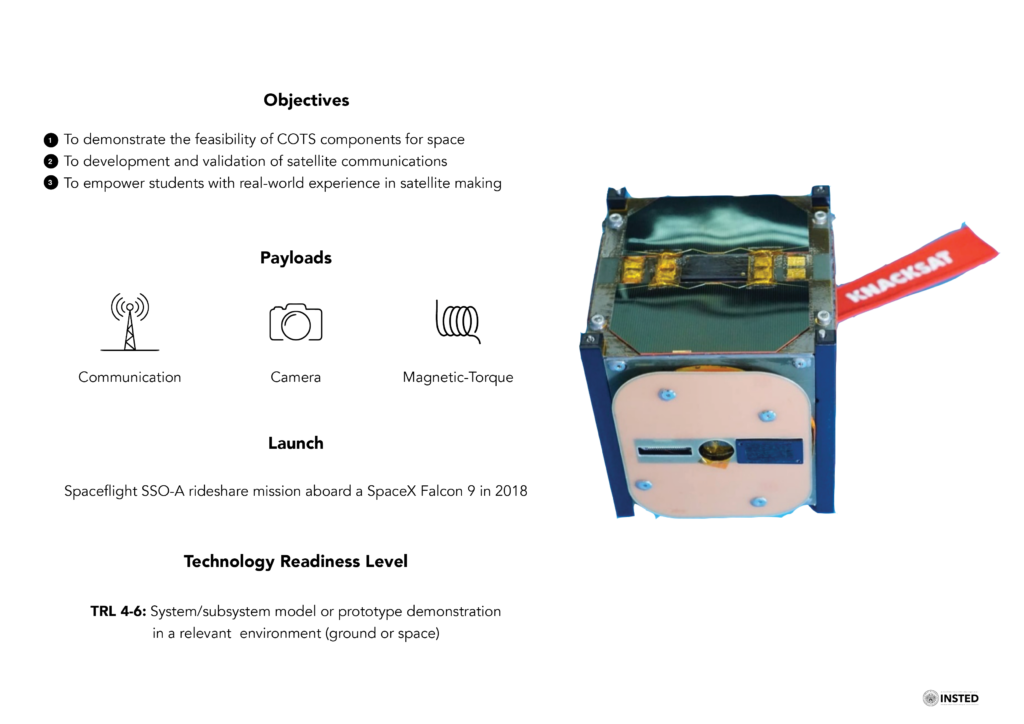
KNACKSAT-1 (KMUTNB Academic Challenge of Knowledge SATellite) is a landmark achievement—the very first satellite fully designed and built in Thailand, and a powerful symbol of what vision, perseverance, and teamwork can accomplish.
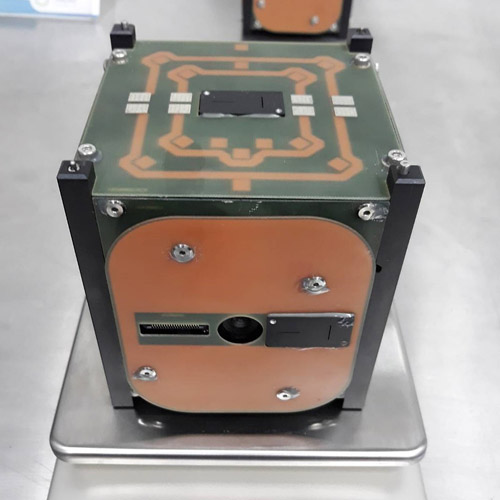
This pioneering 1U CubeSat mission blazed a trail for the nation’s space ambitions, inspiring a new generation to dream bigger and reach higher. KNACKSAT-1 became the launchpad for future innovation, empowering students, engineers, and researchers to turn imagination into reality and to see themselves as leaders in global space exploration. Its legacy is one of hope, courage, and progress, proving that with bold ideas and collective effort, Thailand can achieve greatness among the stars. KNACKSAT-1 was designed with dual educational and technological demonstration goals:
Educational Objectives
- To empower Thai engineers and students with real-world experience in satellite design, integration, and operations, igniting their passion to become innovators and leaders in the space sector.
- To lay the foundation for ever more ambitious national satellite missions, encouraging the pursuit of groundbreaking achievements and technological excellence.
- To spark curiosity and inspire young Thai minds to explore the wonders of space science and technology, nurturing the next generation of space pioneers.
Technology Demonstration Objectives
KNACKSAT-1’s mission experiments targeted key subsystems essential for small satellites, specifically:
- Development and validation of satellite communications using amateur bands.
- Earth imaging from low Earth orbit (using an onboard camera).
- Testing magnetic torque-based attitude control algorithms for 3-axis stabilization.
- Verification of deorbit techniques using magnetic torque (a passive end-of-life method).
- Demonstrating the feasibility of Commercial Off-The-Shelf (COTS) components for space use to reduce cost and development risk.
Satellite Description
| Form Factor: | 1U CubeSat (standard 10 cm × 10 cm × 10 cm configuration). |
| Mass: | Approximately 1.3 kg. |
| Primary Developer: | King Mongkut’s University of Technology North Bangkok (KMUTNB). |
| Communication: | Uses amateur radio frequencies for telemetry, commanding, and data downlink with a ground station. |
This compact structure adheres to the internationally accepted CubeSat standard, making it compatible with rideshare launch opportunities while minimizing development complexity.
Launch & Orbital History
KNACKSAT-1 was successfully placed into orbit on 3 December 2018 as part of the Spaceflight SSO-A rideshare mission aboard a SpaceX Falcon 9 rocket from Vandenberg Air Force Base, California.
- Integration: The CubeSat was integrated into its deployer in the U.S. prior to launch.
- First Signal: The satellite’s first telemetry signal was received on 4 December 2018 at ~09:04 UTC, confirming operational status after deployment.
This flight proved KMUTNB’s ability to manage a full satellite lifecycle from concept to orbit.
Technical Features & Systems
KNACKSAT-1’s design reflected a balance of academic accessibility and flight-worthy engineering:
| CubeSat Bus: | Standardized CubeSat structure with solar panels, power system, and battery. |
| Communications: | ApproxAmateur radio downlink and uplink (typically ~435 – 440 MHz), enabling contact with ground stations. |
| ADCS: | Magnetorquers used for attitude control, testing algorithms for 3-axis stabilization. |
| Imaging Payload: | A small CMOS camera to capture optical Earth imagery for demonstration and outreach. |
| COTS Usage: | Extensive use of commercially available hardware to optimize cost and development time, with in-orbit performance evaluation. |
Impact and Legacy
KNACKSAT-1 accomplished more than just a first launch:
- It proved to the world that Thailand can independently design, build, and operate a sophisticated spaceborne system, demonstrating the nation’s ingenuity, resolve, and ability to compete on the world stage.
- Provided hands-on satellite development experience to Thai students and engineers.
- Set a foundation for the KNACKSAT-2 and KNACKSAT-3 programs, evolving from experimental satellite engineering to multi-payload access platforms and commercial-grade designs.
The success of KNACKSAT-1 also contributed to broader national interest and investment in small-satellite initiatives and academic space programs, demonstrating the tangible results of university-driven space projects.