
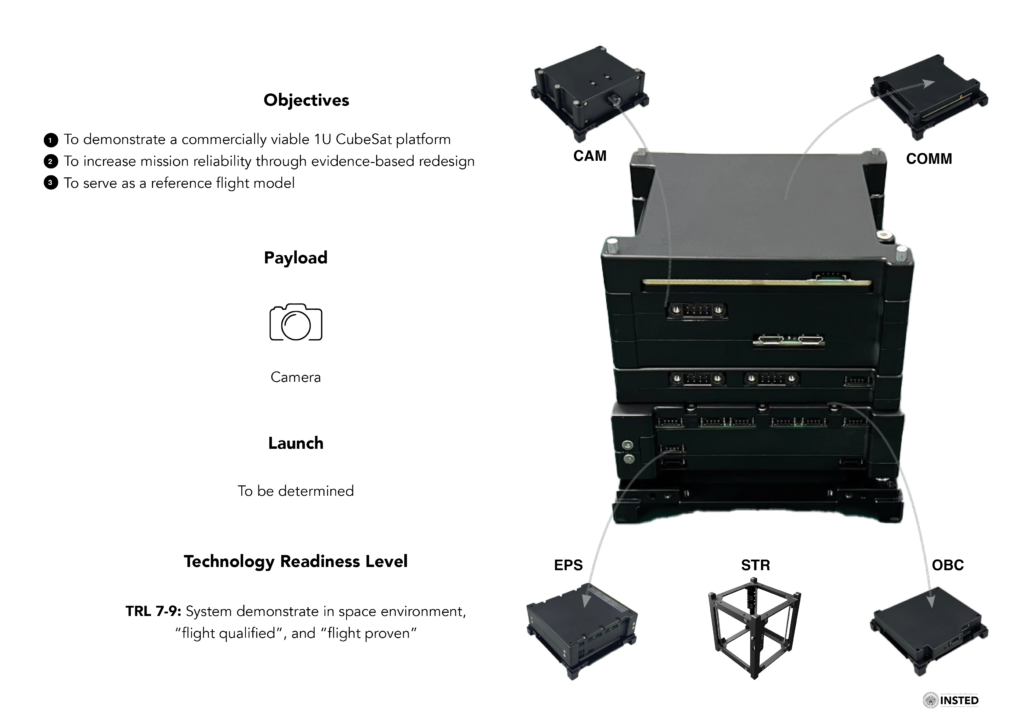
KNACKSAT-3 is a shining testament to Thailand’s relentless spirit of innovation and the power of learning from every challenge. Developed by King Mongkut’s University of Technology North Bangkok (KMUTNB) in collaboration with the International Institute of Space Technology for Economic Development (INSTED) and visionary industry partners, KNACKSAT-3 marks the dawn of a new era—where academic excellence meets commercial ambition, and every lesson becomes a stepping stone to greatness.
Born from the determination to overcome the toughest obstacles in space engineering, KNACKSAT-3 raises the bar in reliability and readiness, setting a new standard for Thailand’s place in the cosmos. Its modular design, rigorous testing, and use of advanced commercial technologies reflect a culture of excellence and courage, inspiring the next generation to dream fearlessly and reach for the stars.
Motivation
The motivation for KNACKSAT-3 arises from three converging factors:
(1) High CubeSat Failure Rates: Despite rapid growth in the small satellite sector, CubeSats continue to suffer failure rates exceeding 40–50%, especially during early mission phases (“infant mortality”). Many failures are linked to:
- Inadequate system-level testing
- EMI and power integrity issues
- Poor RF verification
(2) Lessons Learned from KNACKSAT-1: KNACKSAT-1 successfully reached orbit but experienced:
- Weak downlink beacon signals
- Inability to receive uplink commands
- Suspected EMI coupling between EPS and COMM
- Battery authenticity and screening issues
These shortcomings highlighted the gap between functional launch success and operational mission success.
(3) Commercialization Gap in University CubeSats: Most university CubeSats are designed for education, not repeatable commercial deployment. KNACKSAT-3 was motivated by the need to:
- Transition from “academic demonstration” to “commercial-grade reliability.”
- Bridge university innovation with industry qualification discipline
Objectives
KNACKSAT-3 was developed with the following primary objectives:
- Demonstrate a commercially viable 1U CubeSat platform: Validate that a low-cost, university–industry–developed 1U CubeSat can meet space qualification standards suitable for commercial and operational missions.
- Increase mission reliability through evidence-based redesign: Address the confirmed on-orbit shortcomings of KNACKSAT-1—particularly in power integrity, EMI, and RF performance—using root-cause analysis and system-level testing.
- Establish a repeatable qualification workflow: Create a standardized development and qualification process that can be reused for future CubeSat missions and commercial customers.
- Serve as a reference flight model: Provide a flight-proven baseline for future CubeSat missions, payload demonstrations, and constellation-scale deployment.
Technical Features & Systems
| Form Factor: | 1U CubeSat |
| Dimensions: | ~10 × 10 × 10 cm (P-POD compliant) |
| Payload: | King Mongkut’s University of Technology North Bangkok (KMUTNB).High-resolution camera (~12 MP), 4K video capability at up to 60 FPSKing Mongkut’s University of Technology North Bangkok (KMUTNB). |
| Mass: | < 1.33 kg |
| Orbit class: | Low Earth Orbit (LEO) |
| Mission duration design target: | up to 10 years (radiation equivalent) |
| Architecture Philosophy: | Modular subsystem design, Extensive use of screened COTS components, Strong separation between power, RF, and digital domains, Designed for integration into standardised deployers (P-POD / J-SSOD) |
Launch
KNACKSAT-3 is designed for piggyback launch using standardised CubeSat deployers. Mechanical and environmental qualification aligns with: J-SSOD (JAXA) and P-POD standards. Shock testing was intentionally omitted, consistent with Lean Satellite principles, due to Small mass and enclosed deployer protection. Vibration and thermal vacuum tests fully simulated launch and orbital environments.
Impact and Legacy
The legacy of KNACKSAT-3 reaches far beyond a single mission—it is a beacon lighting the path for countless future explorers, innovators, and leaders. Its journey is proof that when vision meets dedication, a nation can rise to new heights and inspire the world.
- Proves that Thai ingenuity and perseverance can deliver world-class, commercially reliable CubeSats, opening new frontiers for national and international collaboration.
- Validates EMI testing as a critical yet often neglected CubeSat qualification step
- Provides a complete, documented qualification test flow for small satellites
- Establishes a proud Thai-developed CubeSat platform—an enduring foundation for future missions and a symbol of what is possible when talent and ambition unite.
- Deepens the bonds between universities, industry, and global partners, proving that great achievements are born from shared vision and bold collaboration.
- Inspires, trains, and empowers future Thai engineers to lead with confidence, creativity, and a pioneering spirit.
- Lays the groundwork for even more ambitious KNACKSAT missions and innovative platforms, fueling Thailand’s journey as a leader in space technology.
- Supports transition toward: Constellation-based CubeSat missions, Hosted payload services, and Exportable CubeSat platforms
In summary, KNACKSAT-3 marks the transition from experimental CubeSat development to disciplined, qualification-driven, commercially relevant space systems.